
Putting patients at the heart of cancer research
At the heart of cancer research are the people whose lives are affected by cancer. For EORTC, involving patients and advocates in research is essential to ensuring that clinical research addresses not only scientific needs, but also the realities and priorities of those living with and beyond cancer.
As part of the ECRF’s 50th anniversary, we invited Mila, a young adult cancer advocate with lived experience, to share her perspective on patient-centred research, her journey into advocacy, and her hopes for the future of clinical cancer research.
Research that reflects patients’ realities
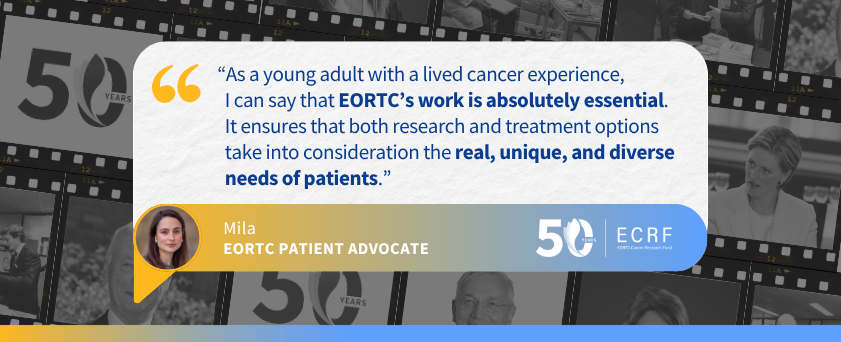
For Mila, EORTC’s work is essential because it ensures that research and treatment take into account the diverse realities of patients. She particularly values EORTC’s focus on quality of life and its patient-centred approach, which she believes helps bridge the gap between scientific progress and patients’ everyday lives.
“Based on my own perspective as an advocate and young adult with a lived cancer experience, I can say that EORTC’s work is absolutely essential. It ensures that both research and treatment options take into consideration the real, unique, and diverse needs of patients. The fact that quality of life is at the heart of everything you do, makes it even more important! Your patient-centred approach makes sure that research is not only scientifically strong and valuable, but also truly meaningful in the everyday life for those affected.”
A journey into advocacy
Mila’s own experience with cancer shaped her commitment to making things better for others. While cancer disrupted many aspects of her life, it also gave her a sense of purpose.
“Cancer changed and disrupted everything. But it also gave me a clear purpose. A calling. I saw and experienced the gaps in the system (from the lack of mental health support, fertility support to the inexistent attention to QoL, and the lack of access to information, long-term side-effects or shared-decision making) and knew that things needed to change. I knew I wanted to help others by providing the support, information, and tools I found lacking before, during, and after my diagnosis. Today, I believe that my advocacy work with DiCE, YCE and EORTC is actively shaping both research and policy discussions. I truly believe that the work we are doing together is already helping others, and that by sharing my lived experience and knowledge, I’m giving voice to many others with similar experiences.”
Shaping the future of clinical cancer research
Looking ahead, Mila is hopeful about the changes she is already seeing in healthcare and research. In her two years as an advocate, she has witnessed progress towards more diverse, equitable and inclusive healthcare, as well as more inclusive clinical trials
What gives me hope is the work that you do every single day. In my 2 years of working as an advocate, I’ve already seen a clear shift towards a more diverse, equitable and inclusive healthcare system, as well as more inclusive clinical trials and research. I’m seeing how we are shaping future healthcare priorities. From patient co-creation in research and policy, to fertility and quality of life being part of the equation, and to a much stronger and more meaningful collaboration between patients, advocates, NGOs, healthcare professionals, and policymakers. In the future I’d love to see how patients are treated and recognised as equals in the decision-making process, and for long-term QoL to become a standard, and the natural endpoint, in every clinical trial.”
The next 50 years of cancer research will be shaped not only by scientific breakthroughs, but by how meaningfully we listen to and involve those living with cancer. For Mila, puttings patients at the heart of research is the way forward.
You can also help support EORTC’s game-changing clinical research to unleash scientific breakthrough and transform cancer patients’ lives. Learn how to GET INVOLVED, or Make a Contribution Now.




Get Social